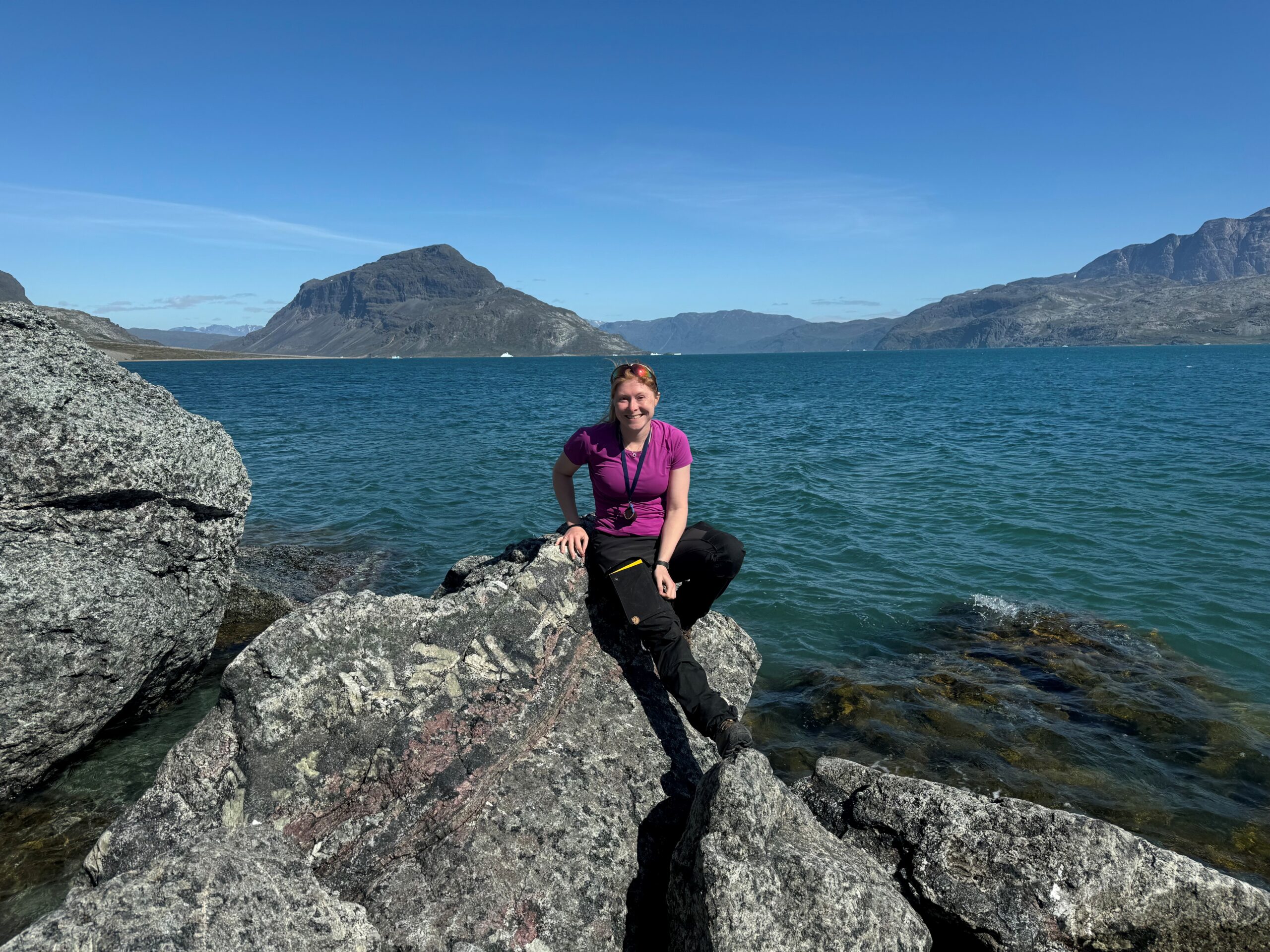
MDSG ECR Distinguished Lecturer Awardee 2027 – Dr Caroline Soderman
We are delighted to announce that Dr Caroline Soderman has been awarded this years’ MDSG Early Career Researcher Distinguished Lecturer Award.
Carrie is a Postdoctoral Researcher within the field of igneous petrology and geochemistry in the Department of Earth Sciences, University of Cambridge. This research focuses on combining field and petrological evidence with geochemical modelling to determine element behaviours and how magmatic processes control critical metal enrichment in a range of igneous systems.
Carrie will be funded to give a series of talks at institutions around the UK and Ireland throughout 2026. If you are interested in hosting Carrie please get in touch by email to: mdsgUK@gmail.com.
Talk options:
Lecture 1 title: From Magma to Magnets: generating magmatic diversity and REE mineralisation in alkaline-silicate igneous complexes
Rare-earth elements (REEs) are critical components of high-strength magnets used in wind turbines and electric vehicles. Alkaline-silicate igneous complexes are major hosts for these elements, featuring a diversity of rock types. However, why some magmatic systems concentrate REEs into economically useful deposits while others remain barren remains poorly quantified. This lecture explores the geological processes controlling magma evolution and REE concentration in these alkaline systems. By combining thermodynamic modelling with whole-rock geochemistry, mineral chemistry, and trace element partitioning, I examine how variables such as magma crystallisation depth, redox conditions, inputs of new magma and interaction with surrounding crust dictate the major and trace element evolution of an alkaline complex. Case studies feature the REE-mineralised Blatchford Lake Igneous Complex (Canada), the barren alkaline plugs of the Erongo Complex (Namibia), and various complexes across the Gardar Province (South Greenland), the latter home to the world-class Ilimmaasaq REE-HFSE deposit. Ultimately, this research aims to provide a framework to determine why some alkaline magmas develop economic mineralisation, whereas others remain barren, aiding future resource discovery.
Lecture 2 title: Interpreting trace element indicators of mineralisation: the importance of partition coefficients in magmatic systems
Finding critical metal deposits requires reliable exploration tools. Often, chemical ‘fingerprints’ in rocks are used to indicate that the magmatic system may have formed a major mineral deposit, even if it is not seen at the surface. For example, high Sr/Y ratios are observed to indicate copper mineralisation potential in arc settings, while low Zr/Hf ratios may indicate rare metal mineralisation potential (e.g. Li, W) in granites. However, interpreting these chemical signatures accurately requires understanding how they are generated in crystallising magmas. In this lecture, I highlight the importance of considering ‘dynamic’ trace element partitioning behaviour between minerals and melt that varies with temperature and mineral composition, rather than considering simplified fixed values for partition coefficients. I focus on two critical metal case studies: a global example of copper porphyry indicators in arc settings; and high-field strength element (Zr, Hf) indicators of rare metal mineralisation in European peraluminous granite systems. In both cases, I demonstrate how the consideration of dynamic partition coefficients, which better match our understanding of partitioning behaviour in nature, can change the interpretation of the magmatic conditions and processes associated with eventual mineralisation.