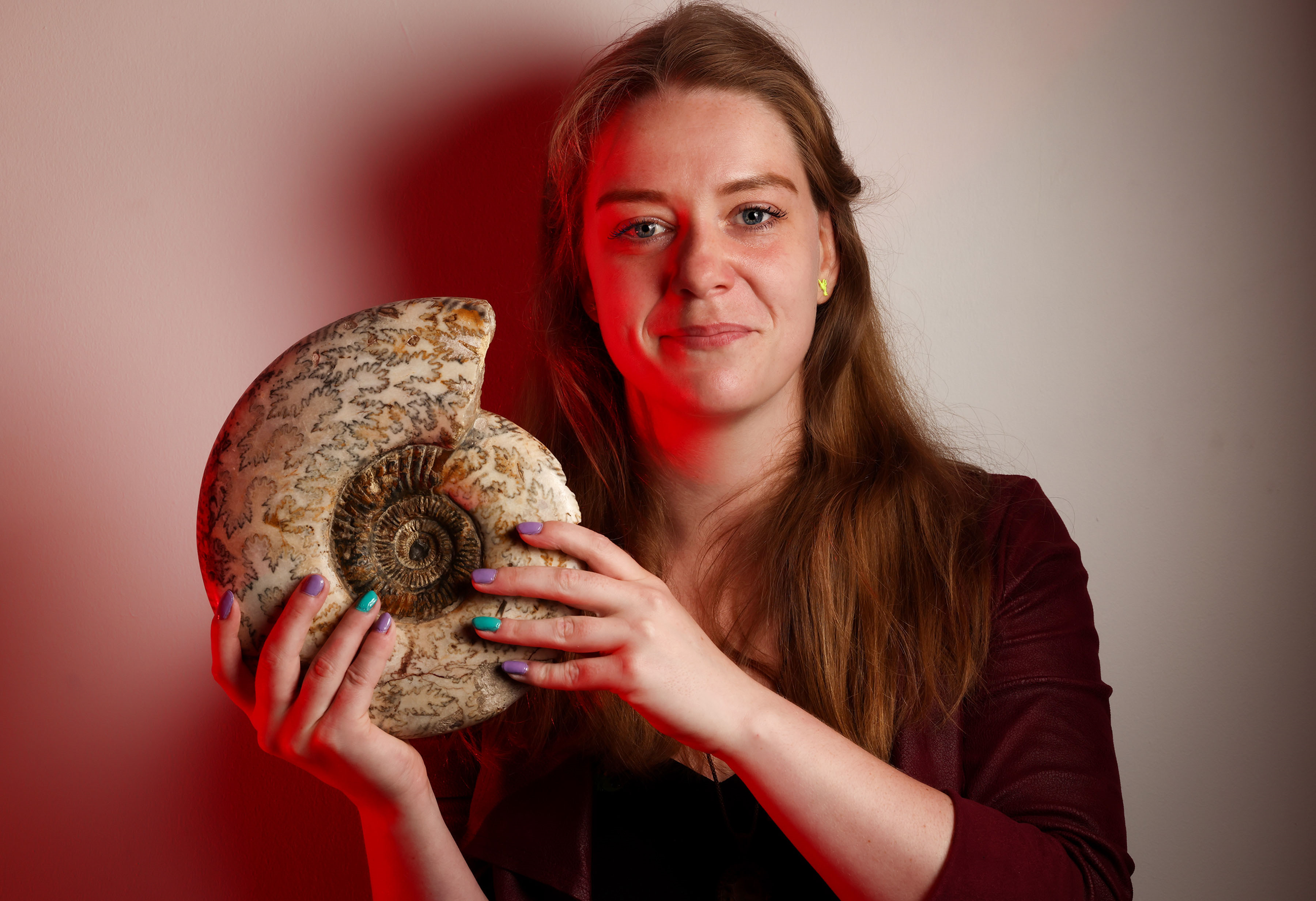
MDSG ECR Distinguished Lecturer Awardee 2024 – Dr Aileen Doran
We are delighted to announce that Dr Aileen Doran has been awarded the inaugural MDSG Early Career Researcher Distinguished Lecturer Award.
Dr Aileen Doran is a post-doctoral researcher working towards understanding sediment-hosted ore systems, hydrothermal fluid processes and geochemical pathfinders to ore. After finishing her PhD at University College Dublin (UCD) on the geochemistry of Irish Zn-Pb deposits in 2021, Aileen joined the iCRAG Copperbelt team at UCD, and is currently studying Cu–Co deposits of the Zambian Copperbelt. Before joining UCD, Aileen worked at Geological Survey Ireland as a graduate geologist on the Tellus project, after finishing her undergraduate degree in geology at University College Cork in 2015. Alongside her academic research, Aileen has also become actively involved in equity, diversity and inclusion (EDI) work to help promote a more welcoming and accessible geoscience.
This award will fund Dr Doran to give several talks at institutions in the UK and Ireland during the calendar year of 2024. Talk titles and abstracts are below – if you are interested in hosting Aileen at your institution, or in attending one of the talks, please get in touch by email to: MDSGECRPLP@gmail.com.
Talk options:
Hydrothermal processes in the southern Irish Zn-Pb ore field: application of clumped C-O and pyrite trace element analysis
The global adoption of climate action initiatives have amplified the push for ‘green’ technologies increasing demand for metals such as Zn & Cu. However, as the rate of metal discovery is currently insufficient to meet demand, innovative thinking and the utilization of novel, multi-method approaches are crucial to enhance our understanding of base metal deposit formation and guide development of new vectors to mineralization. The Irish Zn-Pb Orefield, a vital source of Zn for Europe, offers promise in addressing the knowledge gaps in ore geology studies, with well-characterised deposits like Lisheen and Galmoy providing robust platforms for testing new methods to guide future exploration. In the Irish Orefield, pyrite, calcite and dolomite are common phases in both unmineralized and mineralized areas, and are associated with all ore stages. Clumped C-O isotope analysis represents a novel technique for the acquisition of accurate carbonate precipitation temperatures, allowing calculation of fluid δ18O values. Pyrite trace element chemistry shows increasing promise for geochemical vectoring towards mineralization, with As-Tl variations recently identified between orebodies and surrounding sub-economic haloes at Lisheen. This presentation introduces ground-breaking multi-method approaches utilizing carbonate clumped C-O isotopic and pyrite trace element analysis to unravel the enigmatic processes underpinning ore genesis.
Interpreting the Neoproterozoic metasedimentary succession of the Central African Copperbelt: geochemical applications to aid in deciphering sedimentary environments
Copper and cobalt are critical to many renewable technologies, yet global demand outpaces their availability, with discovery rates decreasing. The Central African Copperbelt (CACB) is a globally important source of Cu-Co, with the Zambian Copperbelt one of the world’s largest suppliers. The Neoproterozoic Katangan Supergroup, composed of carbonate and siliciclastic metasedimentary succession, hosts these key resources with deposits often hosted in lower stratigraphic intervals. Consequently, the upper sedimentary successions remain relatively understudied, with limited understanding of original depositional environments and post-depositional alteration (e.g., diagenetic, hydrothermal, metamorphic). But as exploration moves into deeper stratigraphic levels and more complex geological settings, a holistic understanding of the evolution of these units is crucial both for targeting of deposits in rocks stratigraphically below and to explore for the new deposit types being identified high in the stratigraphy. Coupled isotope, mineral chemistry, and lithostratigraphic studies can yield this crucial understanding, helping to decipher the original sedimentary environments as well as define post-depositional processes. This talk will explore the Zambian Copperbelt’s sedimentary succession, introducing new insights from ongoing research. Additionally, this talk will explore the impact of ‘parachute science’ on our current approaches to studies of the CACB with discussion on how we as a community need to move forward to ensure inclusive research for all.